
There is great interest in AI in municipal IT operations. Equally great is the uncertainty: what happens to every single personal data, internal decision and sensitive processing information when it is processed by an AI model? This is a review of how it can actually be solved, and what requirements you need to set when evaluating AI support in your operations.
Why data localization is crucial for the public sector
A case in a pure case management system may contain information about medical conditions, family status or finances. This is data that should never be processed by an external AI model outside the EEA without a carefully thought-out agreement and documentation. For a private organization, it is a risk assessment. For a municipality, it is often a legal impossibility.
The problem with many cloud-based AI services is not that they are bad, but that by design they send data to servers outside Sweden, sometimes outside the EU, for processing. This creates a situation where IT managers and administrative managers see what AI can do in theory but cannot use it in practice.
This is not a niche problem. In conversations with municipalities and regions over the past year, the same question has recurred: “Can we use AI if the data is not allowed to leave Sweden?” It is exactly the right question to ask.
What is Model as a Service and why is it relevant?
Model as a Service (MaaS) is a way to deliver AI models as a service within a defined infrastructure. Instead of data being sent to a global cloud, it is processed by a model running on servers within Sweden's borders, or within the organization's own infrastructure, depending on procurement and requirements.
For the public sector, this means that AI support can be used on data that would otherwise not have been processed. The organization retains control over where the data is and how it is used. It is the technical solution to the question we have heard over and over again.
However, it requires that the platform and infrastructure are built for it from the start. AI that is “added on” from an existing process is something completely different than AI that is integrated into the platform where the work actually happens.
How AI support works in Easit GO
Easit GO is a service management platform used by municipalities, regions and larger organizations to manage IT services, internal services and issues across the business. AI support in Easit GO is integrated directly into workflows, not as an external tool that the user has to navigate to separately.
GO Connect, the integration layer in Easit GO, enables connectivity to AI models and APIs in a way that allows for requirements on where processing takes place. It is the technical foundation that enables locally or regionally hosted AI models and makes it possible to meet the requirements of the public sector.
This means that the AI support can provide suggestions directly when a case is created, help the case manager find relevant solution articles or summarize a case for forwarding, without the data leaving the Easit GO environment.
Concrete use cases in municipalities and regions
Below are three use cases that are realistic with a properly configured platform. What they have in common is that the caseworker is always in the decision-making chain. The AI support prepares, suggests and summarizes. The decision is made by a human.
- Automatic categorization of incoming cases. When a resident or employee submits a question, AI support is often able to suggest the correct category and case manager immediately, reducing manual sorting and shortening processing time.
- Suggested solution articles. AI can connect a new case to similar cases or to relevant knowledge articles in the system and present the suggestions to the caseworker without making a decision.
- Automated response suggestions for common questions. For standardized questions where the answer is simple and predictable, AI support can generate a suggested response that the handler approves before it is sent.
What requirements you should set when evaluating AI support
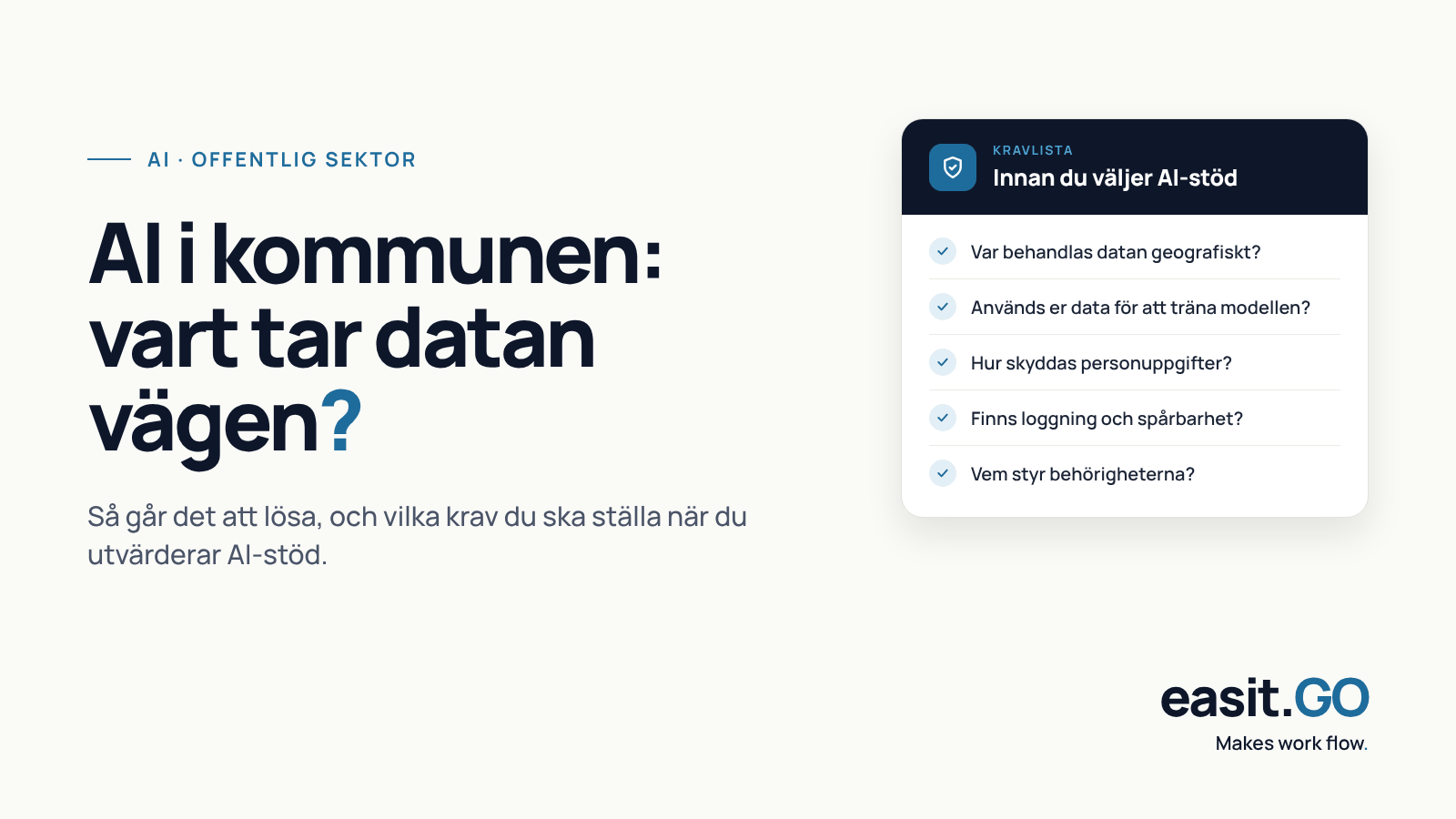
When a municipality or region evaluates whether AI support is useful in practice, a few questions are crucial:
- Where is the data processed? It is not enough for the supplier to say “we comply with GDPR”. Require written documentation of where AI processing actually takes place, on which servers and in which country.
- Is the AI support integrated into the tool we are already working in? AI running outside the daily business system is rarely used in the long term. Integration is a prerequisite for actual use in everyday life.
- Can we set requirements for which model is used? The flexibility to change AI models when technology changes, or when a new procurement occurs, protects the organization from being locked into a supplier.
- Is it possible to run the model locally? For the most sensitive use cases, it may be a requirement that the AI model runs on its own infrastructure, without external connectivity. Ask this question early in the evaluation.
Summary
AI in the public sector is not impossible. It requires the right infrastructure, the right architecture and a platform where AI is built into the workflows from the start. For municipalities and regions that want to take the next step without compromising data protection, Model as a Service, combined with a service management platform built for it, is a concrete way forward.
Read more about how Easit GO supports AI integration at easit.se/easit-go/ and about GO Connect at easit.se/easit-go-go-connect/

Henrik Traveler
Commercial Product Manager
henrik.resare@easit.com
+46 70 249 36 06