About the designer's role in a service management platform and why it becomes more important as AI takes over
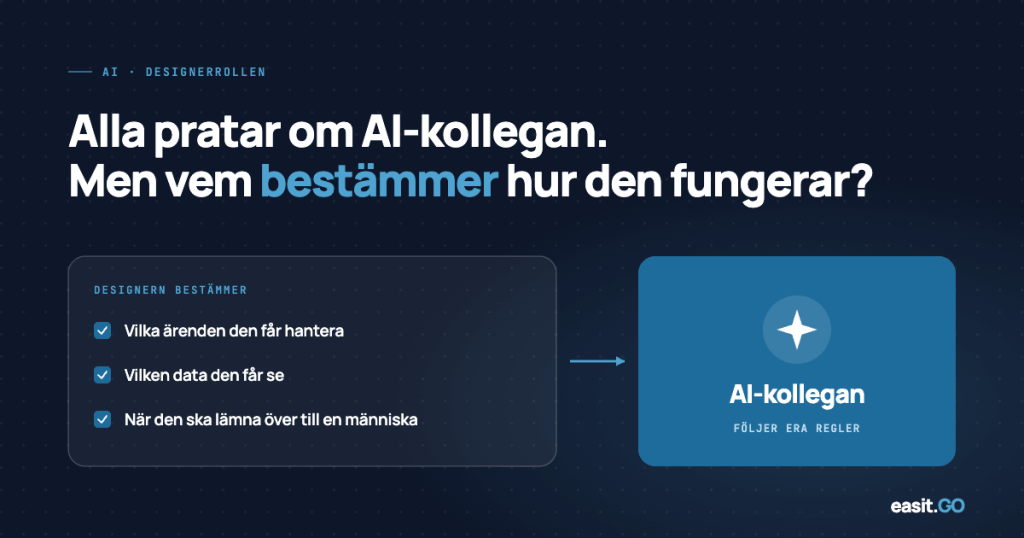
There’s a lot going on in the industry right now. Competitors are launching AI colleagues with names, faces, and promises to take care of the repetitive tasks. That sounds great. But there’s one question none of them seem to be asking: who in your organization decides what the AI colleague will actually do?
Who sets the escalation rules? Who defines which form fields should be present? Who decides which cases should be automatically assigned to which teams, and under what conditions? It's not AI that does that. It's a human. And that role has a name.
The industry is talking about AI. Few are talking about the person who controls it.
In recent months, several service management platform vendors have introduced AI capabilities with great fanfare. Tools that automate case responses, suggest solutions, and build workflows based on description. It's technology that actually works, and that removes a number of time-consuming tasks.
But in all the communication about AI colleagues and smart assistants, there is a perspective missing: these tools only work if someone has configured the system they live in. The rules, the roles, the forms, the escalation chain. The person who has done it is not a consultant who was in for three weeks during the implementation. It is an internal resource who owns the system, understands the business and can change it when needs change.
The designer role: owning the system from the inside
In Easit GO, this role is called a designer. It is an internal resource, often with an IT background but not necessarily, who has the authority and skills to shape how the system looks and works. Without coding. Without having to hire external consultants for every change.
A designer in Easit GO works in Design Studio, a no-code tool for creating and adjusting workflows, forms, and process logic. It is a graphical interface and is designed for a business person to use independently.
What does a designer do specifically?
- Creates and customizes forms for different case types
- Sets up roles and object permissions
- Configures escalation rules, message rules, and object rules
- Builds and adjusts workflows as business changes
- Customizes views and interfaces for different roles in the organization
It's that person who decides whether the system feels right or wrong for those who use it every day. And it's that person who makes sure that AI features, automations, and integrations actually reflect how the organization works.
Hiring consultants should be a choice, not a must
A fundamental idea behind how Easit GO is built is that the organization should be able to own its platform. Hiring consultants should be a choice, not something you are forced to do in order to make changes to the system.
It sounds simple, but it's actually quite unusual. Many service management platforms are designed in a way that creates a continuous consultant dependency. Every customization requires an order, a project, and an invoice. This means that the system lags behind the business.
With an internal designer who owns the configuration, the organization can react quickly. A new process takes days, not months. A change to a form is made immediately. Escalation rules are updated when the organizational structure changes, not three months later.
What happens when AI meets a system no one owns?
That's the question missing from most product launches right now. AI colleagues and automation tools are presented as solutions in themselves. But an automation tool that runs in a process that no one maintains is not a solution. It's a faster way to do the wrong thing.
Organizations that have invested in internal design expertise are in a better position to embrace new AI capabilities. They have a system that is current, accurate, and rooted in how the business actually works. That’s the foundation AI needs to deliver value.
Concrete example |
An AI function that automatically handles incoming cases based on category and priority works well if the categories are properly defined and the prioritization logic reflects reality. It is the designer who ensures that. It is the designer who adjusts it as the business changes. |
It's about in-house competence, not technology
The discussion about AI in service management is often about features and technology. What AI can do. How fast it can be done. How little manual work is required. These are relevant questions, but they miss a dimension.
The real question is: do you have the skills internally to configure, manage and further develop your platform? Because it is that skills that determine whether you can actually benefit from what AI offers.
Easit offers training specifically for the designer role, and for the administrator role, which is a prerequisite for understanding how the platform is structured. More about what these training courses contain and how they are structured can be found in our guide to the Easit GO training courses.

Henrik Traveler
Commercial Product Manager
henrik.resare@easit.com
+46 70 249 36 06