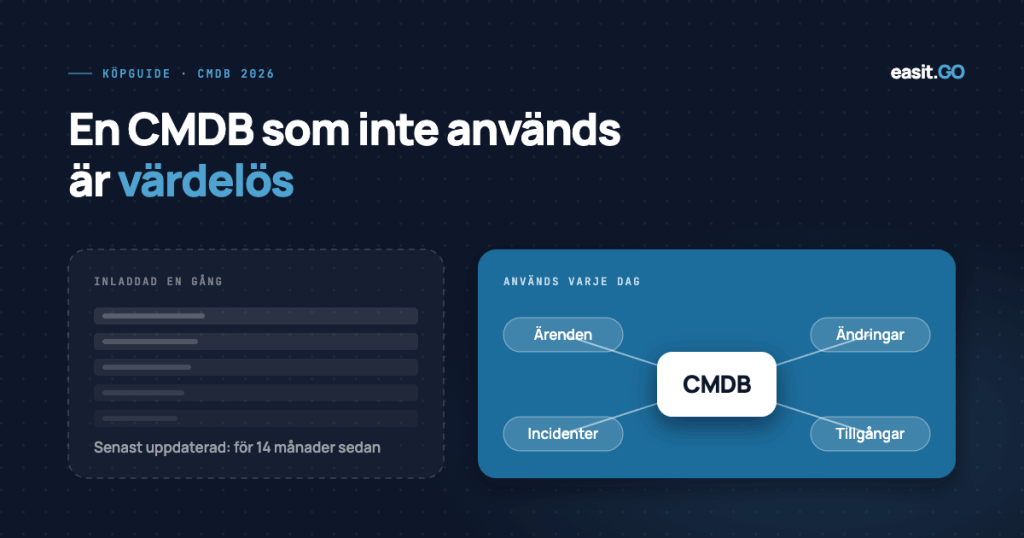
A CMDB that is not used is useless. It sounds simple, but this is where many CMDB efforts fail. You choose a tool, load data from an Excel sheet or an old inventory, and then don't reach out to the users to maintain and use the information in their daily work.
This guide is for those of you who are evaluating CMDB solutions for a Swedish organization in 2026, regardless of whether you are in the public sector, private business, or on an IT team that wants to really get their configuration objects in order.
Why most CMDB implementations fail
There are two common failure strategies that organizations make when implementing a CMDB. The first is to over-design. You start by modeling the entire IT environment, defining hundreds of attributes and relationships, and never get to a stage where the CMDB is actually used. The second is to under-deliver. You import an inventory, call it a CMDB, and wonder why no one trusts the data.
A good CMDB in 2026 needs three things:
- Integrations that keep data updated automatically — otherwise it becomes outdated within weeks.
- Connection to case and incident management — so that the CMDB is actually used in daily work.
- An architecture that can be expanded step by step — not a requirement that everything must be ready from day one.
Are you new to the CMDB concept? Read our introduction: What is a CMDB and how do you get started?
What to Value in a CMDB Tool in 2026
1. Automatic discovery and integration
Manual data entry always goes awry sooner or later. Consider whether the tool has built-in discovery or if it integrates with existing inventory and monitoring solutions. From there, the data can flow in automatically and you won't have to rely on individual technicians updating records.
Ask the vendor: What sources do you support for automatic import of configuration objects?
2. Connection to service management processes
A CMDB without a connection to your cases, incidents and changes is just a database. What makes the CMDB valuable is when you can see directly in a case which CI is affected, what dependencies it has and who is responsible for it. So don't evaluate the CMDB module in isolation but how it integrates with the rest of the platform.
In an ITSM system like Easit GO , the CMDB is an integrated part of the platform, not a separate tool that you have to manually synchronize. See also: Best Incident Management Systems 2026.
A CMDB can also be a central part of a broader ESM strategy. Read our guide to ESM companies in Sweden 2026 if you want to understand the big picture.
3. Scalability and installation freedom
Start small and build out. The best CMDB tool is one that you can actually deploy and use in the first few weeks, not one that requires a six-month implementation project. Evaluate whether the tool supports a phased rollout where you start with IT equipment and gradually expand to other types of configuration objects.
4. Transparency regarding data management and data storage
For Swedish organizations, not least in the public sector, questions about where data is stored and who has access to it are critical. GDPR, NIS2 and the organization's own IT security guidelines require documented data processing. Choose a supplier that can answer these questions clearly.
Common pitfalls when choosing a CMDB tool
- You are choosing a global enterprise tool for an organization that does not have the resources to manage it. Large platforms often require dedicated administrators and consultants to deliver returns.
- You separate the CMDB from the case and incident management. Two systems that never really talk to each other provide half the benefit at double the cost.
- You import old data and call it a CMDB. A CMDB full of outdated information is potentially more dangerous than no CMDB, because it creates a false sense of security.
- You fail to define responsibilities. Who owns a CI? Who is responsible for documenting relationships? Without clear ownership, maintenance quickly breaks down.
What distinguishes a good CMDB solution from a generic one?
The best CMDB implementations we have seen in Swedish organizations have a few things in common. First, they start with a limited scope: they select five to ten CI types that are critical to the business and focus on getting them right. Second, they connect the CMDB to real processes early on, so that the data is actually validated in daily work. Third, they set up automatic discovery from day one, so that manual input is minimized.
A CMDB doesn't have to be perfect to be useful. It needs to be up-to-date enough and easy enough to use for case managers to actually use it when handling a case.
In Easit GO , the CMDB is a built-in part of the platform. Configuration objects are directly linked to cases, incidents and changes. This means that the data is validated and used in daily work, not just during quarterly reviews.
How to choose the right CMDB tool for your organization
When evaluating CMDB tools for a Swedish organization in 2026, we recommend that you start with the following questions:
- Does the CMDB integrate naturally with the case management system we already use?
- Does the system support automatic discovery from our existing monitoring sources?
- Can we start small and expand over time without having to reimplement?
- Where is the data stored and does it meet our GDPR and NIS2 requirements?
- Can the supplier show reference customers from similar Swedish organizations?
If the answers to these questions point in the right direction, you are well on your way to a CMDB implementation that actually delivers value.
Curious about what it might look like in Easit GO? Contact us here and we'll tell you more!

Henrik Traveler
Commercial Product Manager
henrik.resare@easit.com
+46 70 249 36 06