Most organizations with a certain number of IT systems have management plans, or should have. The problem is rarely the ambition.
It's that the plans live in documents and files that were last updated when the system was implemented, do not reflect what the responsibility actually looks like today and are not connected to the processes that surround the system.
The document that no one finds and the process that everyone needs
A governance plan is fundamentally simple. It describes who owns a system, what it is used for, how it is managed, and what happens throughout its life cycle. It is information that everyone in the organization who works with or is affected by the system needs to have access to.
But in most organizations, that information lives in a Word document on a SharePoint page that no one knows how to find. The system owner has changed, but the document still says it's the old manager. The contract expired a year ago, but no one updated the plan.
It's not a documentation problem. It's a process problem. A management plan that lives detached in a document is a snapshot. A management plan that lives in a process is a living document.
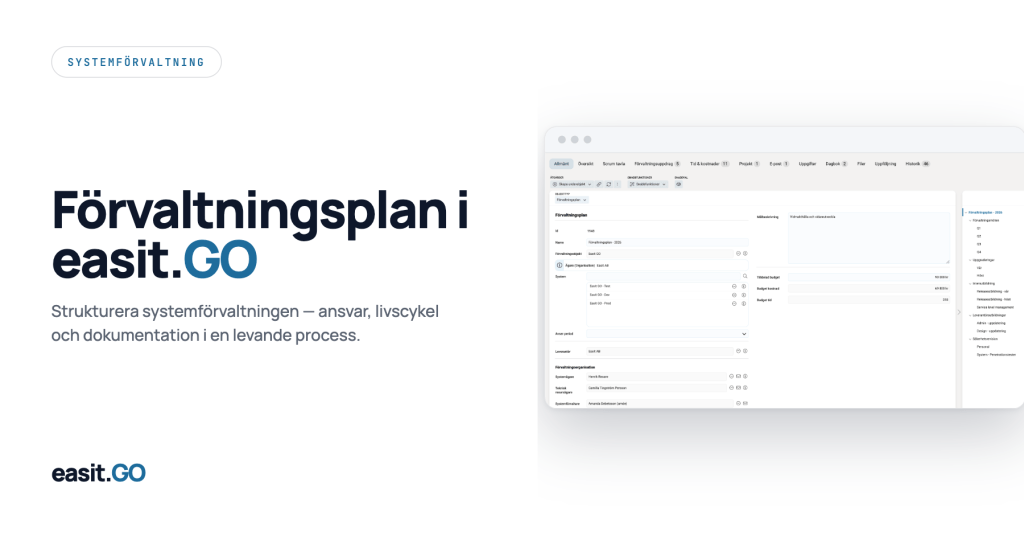
What a management plan in Easit GO contains
In Easit GO, each IT system is represented as an object, a system record, with structured attributes and relationships. This is the basis for the management plan.
System owner and administrator. Who owns the system from an operational perspective and who manages it technically. The roles are clearly linked to actual users in the system, not to names in a text field.
Lifecycle and planned events. Current version, next planned upgrade, support end date. The information is not static, it is updated when something changes and can trigger notifications and tasks automatically.
Dependencies and integrations. Which other systems depend on the current system and which systems the current system depends on. With relationship models in Easit GO, you can visualize these connections directly, without having to draw a new diagram every time something changes.
Agreements and costs. Agreement period, supplier, cost and renewal date. Linked to the object and visible to those who need to see it.
Incidents and changes. All cases, incidents and change requests linked to the system are visible in their context. This means that the administrator does not need to search in a separate system to understand the history.
Why the public sector needs this more than most
Municipalities, regions and government agencies often work with management models such as pm3 or similar frameworks. They require documented system ownership, clear lifecycle plans and routines for management and decommissioning.
It is part of how IT governance can or should function in operations that handle citizens' data and critical societal functions.
The challenge is that these requirements are often met with documentation. Reports and plans that are produced prior to an audit and then added to the documents. In Easit GO, the management plan is instead handled as part of the daily work, the system owner updates, the administrator logs, cases are automatically linked. The result is a document that actually reflects reality when the auditor asks.
The management plan as a hub for the entire life cycle of the system
What distinguishes a management plan in Easit GO from a document is that it is active.
When a new agreement is signed, the system record is updated. When a dependency changes, the relationship model is adjusted. When a new version is planned, a task is created for the affected administrators. When a system is to be decommissioned, a decommissioning process starts with the required steps, and Easit GO ensures that nothing is forgotten.
This means that the management plan is not something you produce. It is something you work on and that is alive.
Frequently asked questions
What should a management plan contain?
The purpose and scope of the system, system owners and managers, life cycle and version planning, dependencies, agreements and costs, and procedures for incidents and changes. In Easit GO, all of this is collected in a structured system object.
Why does the public sector need management plans?
Municipalities and regions often work with management models such as pm3 that require documented ownership and lifecycle management. A living management plan in Easit GO meets the requirements and keeps them updated continuously.
Can management plans be managed in Easit GO?
Yes. System objects with ownership, agreements, lifecycle, dependencies and linked case history – all in one platform, configurable by your designer without code.
A management plan that no one finds helps no one. One that lives in your everyday life, and reflects what responsibility actually looks like today, is a strategic basis.
Want to see what system management can look like in Easit GO? Book a demo
Read also: Information classification and access management: Do you know who has access to what?

Henrik Traveler
Commercial Product Manager
henrik.resare@easit.com
+46 70 249 36 06