
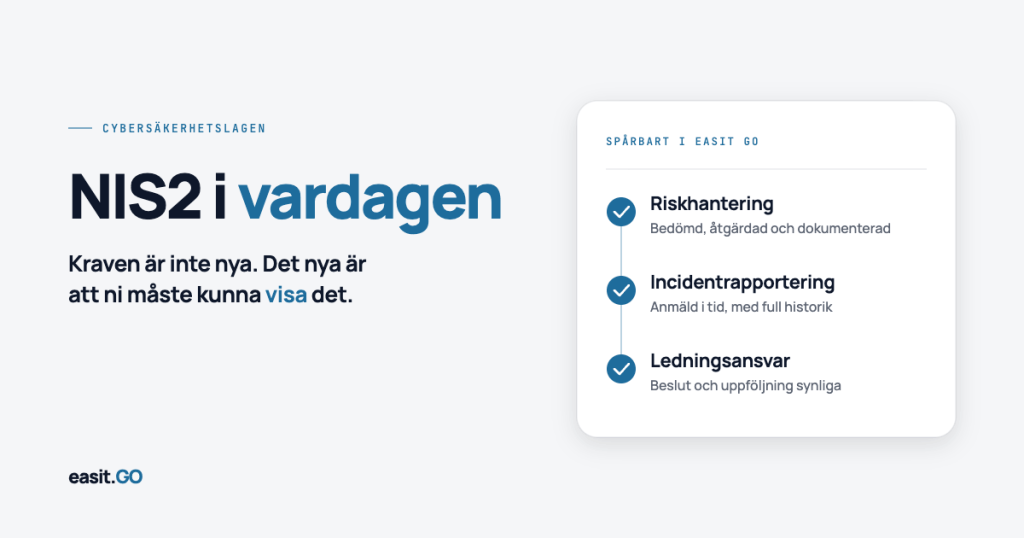
The NIS2 Directive, which is implemented in Sweden in the Cybersecurity Act, requires that organizations critical to society manage risks systematically, report incidents in a timely manner, and take management responsibility for security work. The requirements are not new in substance. What is new is that you must be able to demonstrate that you meet them.
That distinction is important. An organization that handles incidents manually, has risk registers in spreadsheets, and reviews suppliers via email may meet the requirements in substance but has difficulty producing the documentation that oversight and management need. That's where the service management platform makes a difference.
What NIS2 actually requires
Article 21 of the NIS2 Directive lists ten areas of action, but they basically fall under three requirements: managing risks systematically based on risk analysis, reporting significant incidents in a timely manner, and ensuring that management takes responsibility, follows up and trains itself.
Timeline for a significant incident: 0 h registration, 24 h early warning (suspected intent? cross-border impact?), 72 h incident notification with assessment of severity and indicators, 1 month final report with cause and measures.
Six processes that work together
Service Catalog: NIS2 Continuity Requirements
What services you deliver, who owns them and how critical they are. In Easit GO, the service catalog is the hub that the other processes connect to. When an incident occurs, the caseworker immediately sees which critical services are affected and can answer the regulator's questions without having to search multiple systems.
Configuration and Assets (CMDB): NIS2 Asset Management Requirements
NIS2 requires security in the acquisition and maintenance of network and information systems. The CMDB in Easit GO contains systems, equipment and dependencies linked to each service. This gives you an up-to-date picture of your IT environment without manual registry work.
Change Management: NIS2 Requirements for Procurement, Maintenance and Traceability
Each change is linked to the affected services and assets. The relationship overview shows what is affected before the decision is made. The change council approves or rejects. When the change is implemented, the CMDB is updated, and the history shows who approved, when, and why.
Incident Management: NIS2 Incident and Reporting Requirements
The security incident in Easit GO asks questions that determine whether the incident is 'significant': type, suspected intent, cross-border impact and consequences. The time monitoring for 24 hours, 72 hours and one month is run directly in the case. The basis for the report is taken from the incident's own fields.
Read our guide: Guide to implementing Incident Management.
Risk management: NIS2 requirements for risk analysis and policy
Risks are registered with threat profile, probability, consequence and risk value, linked to the services and assets they threaten. Each risk has a responsible party, a deadline and an approver. History shows that the risk is managed on an ongoing basis, not that it was noted once and forgotten.
Supplier Management: NIS2 Supply Chain Requirements
Suppliers are linked to contracts, services and equipment with certifications, security requirements and risk classification. Audit requests are sent directly in the system with forms and response deadlines. Deviations are followed up with an action plan in the same flow.
Read our guide: Guide to implementing Supplier Management.
Where do you start?
Not with everything at once, but with what has the greatest impact first. A natural starting order: start by securing the incident flow with NIS2 classification and time monitoring. Then connect critical services to CMDB and change management. Secure the supply chain. Then expand with risk registers and management reports.
Three lessons from organizations that have gotten started: Start at the incident, not at the policy. The CMDB doesn't have to be complete from day one; the right data about a few critical services beats half-baked data about all of them. Security and IT in the same tool eliminates gaps.
Read more about how Easit GO handles NIS2 requirements at easit.se/nis2/ or contact us to place your current position on the ladder and choose where to start.

Henrik Traveler
Commercial Product Manager
henrik.resare@easit.com
+46 70 249 36 06