The market is full of tools that promise to digitize and automate public operations. But the public sector has rules that differ significantly from the private sector, and most tools are built for someone else. This guide will help you ask the right questions, avoid the most common mistakes, and find a tool that actually meets your requirements.
1. What makes digitalization in the public sector different?
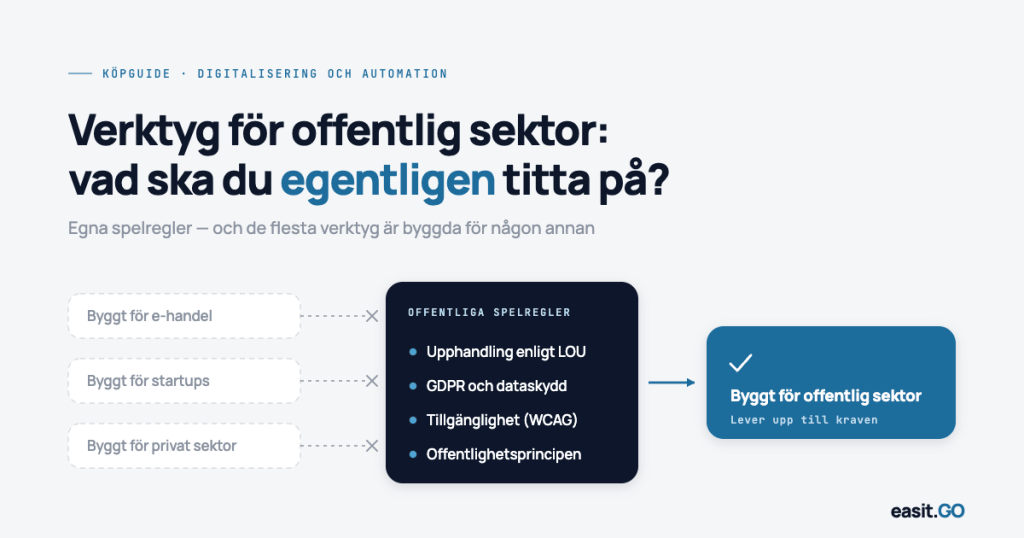
When a private organization introduces a new tool, the decision is often about efficiency and cost. For authorities, regions and municipalities, there is an additional layer of requirements that affect both which tool you can choose and how it must be configured.
The principle of public access means that the public has the right to access public documents. This requires that the system can show a complete and tamper-proof history of every case, every action and who performed it. Tools without built-in audit trails do not meet this requirement.
The General Data Protection Regulation (GDPR) applies across the EU, but public sector organisations often handle sensitive information about citizens. Questions about where data is stored, who has access and how personal data is deleted upon request must be answered by the supplier before procurement. For organisations also evaluating whether a European platform is a better fit than a US alternative, our article on European ITSM platforms be a useful complement.”
The Public Procurement Act, LOU, governs how purchases may be made. This means that a tool that is not included in an existing framework agreement requires a new procurement process that can take several months.
Added to this are practical requirements: integration with existing systems such as Active Directory, financial systems and HR platforms, support for Swedish language and terminology, and support during Swedish office hours. These are requirements that foreign suppliers with global support models do not always meet.
2. Three types of tools on the market
To make the right choice, you first need to understand what type of solution you are evaluating. The market offers roughly three categories.
General project and workflow tools
There is a large category of tools built for flexible project work and task management. They are easy to get started with, support collaboration, and often offer a nice user experience. The problem is that they lack the structure that the public sector requires: no built-in traceability at the case level, no built-in roles with access control adapted to government structures, and no natural handling of cases that span multiple departments.
They can work well for limited projects, but they are rarely the right choice when you want to digitize a business's ongoing case and service flows.
Function-specific solutions per department
A common path in the public sector has been to choose one tool per function: one for IT support, one for HR matters, one for property notifications. This has led to a situation where many organizations run four to six separate systems with their own contracts, their own data silos and their own integrations to maintain.
The cost is rarely just the license cost. Every system requires training, administration and integration with surrounding systems. When employees change roles or when a case affects more than one department, gaps arise that must be resolved manually.
Service management platforms with support for multi-department work
A third category are platforms that are built from the ground up to handle service and issues across departmental boundaries. They have built-in traceability, role-based access control, automation flows and support for multiple departments sharing the same platform with their own processes. An ESM platform for Swedish organizations allows HR, real estate, and legal, among others, to manage their services with the same structure as IT without each department needing its own system.
It is this category that best meets the public sector's overall requirements, but not all platforms in that category have equally strong support for the requirements that are unique to Sweden and European public administration.
See what a modern service management platform includes
Easit GO is built for organizations that need a platform, not a new silo. Read about the platform's features and what they mean in practice.
Read more: easit.se/plattformens-funktioner/
3. The criteria that determine whether the tool is suitable for your organization
When evaluating tools for a public sector organization, we recommend that you assess each candidate against the following criteria:
- Data protection and storage: Where is your data stored? European cloud storage, the ability to run on your own server space or a clear data processing agreement are minimum requirements for most public actors.
- Traceability and logging: Can the system show a complete and tamper-proof history of every case and action? This is a requirement that follows directly from the principle of public access.
- Procurable: Is the supplier on an existing framework agreement? If not, how long would a separate procurement process take and do you have the resources for it?
- Integration with existing systems: Can the platform talk to your Active Directory, your HR system, and your financial systems? And how much does that integration cost in time and money?
- Support in Swedish, during Swedish business hours: When something goes wrong in a critical operation, you need help fast. A global support model with English-speaking first-line support is rarely enough.
- Scalability and multi-department support: Can the same platform be used by IT, HR, property and citizen services? Or do you need a new system per department?
- Adaptability without coding: Public organizations often have unique processes. Can the platform be adapted by your own administration without hiring consultants for every change?
4. Five questions to ask a supplier in procurement
Once you have a shortlist of candidates, ask these questions directly in the dialogue with the supplier. The answers will quickly reveal whether they have the experience and technical capabilities required.
- Where is our data stored and how are access rights handled under GDPR? Can you show a current Article 30 list?
- What does your logging and traceability look like at the case level, and has the system been approved or used by other Swedish authorities or municipalities?
- What framework agreements are you contracted under, and if we need to conduct a separate procurement, how will you support us in that process?
- How is integration with Active Directory, HR systems and financial systems handled? Is it included in the basic license or is it optional?
- Can you give us three reference customers in the public sector in Sweden that we can contact, and who use the platform for more than one department's matters?
5. What will Swedish authorities and municipalities choose in 2026?
The trend in the Swedish public sector is clearly moving away from function-specific systems towards platforms that can carry more of the business' service flows. This is driven by three forces.
The first is the NIS2 directive, which requires critical infrastructure organizations to demonstrate traceable and controlled IT processes. This has driven IT departments to review their systems and requires that processes be documented and monitored.
The second is economic pressure. With fewer resources to allocate, municipalities and authorities want to reduce the number of system agreements and the administrative cost of managing multiple parallel solutions. A platform that security, property and IT support can use together is cheaper to manage than three separate systems.
The third is employee experience. When the same employee has to navigate four different systems to do their job, efficiency decreases and frustration increases. A unified platform provides a unified experience.
The organizations that succeed best with digitalization are those that choose to flatten their process silos and choose a platform that can grow with them, rather than patching up one system at a time.
Do you want to see how Easit GO works for your type of organization?
Book a short demo and we will show you what the platform looks like in practice for an organization with your requirements.

Henrik Traveler
Commercial Product Manager
henrik.resare@easit.com
+46 70 249 36 06