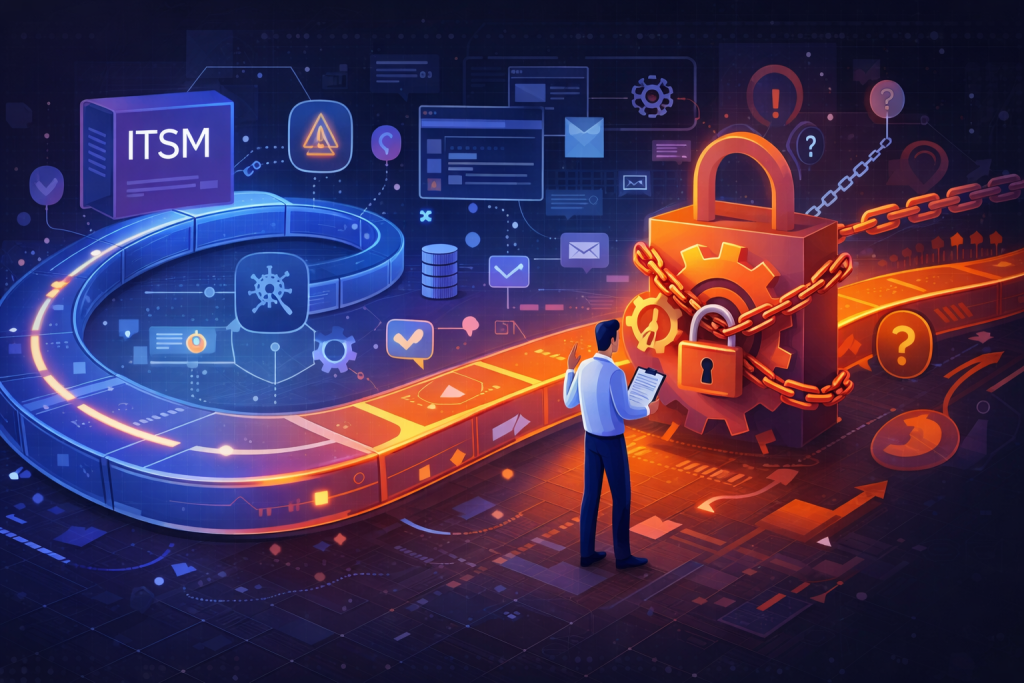
Many organizations are not stuck because they chose the wrong ITSM system.
They are stuck because the systems cannot be changed in line with the business.
That is a crucial difference.
IT Service Management as a discipline often works well. Incidents are handled, changes are documented, issues are followed up. The processes are there. Yet a sense of stagnation arises.
Why?
When processes move outside the system
A clear sign is when mission-critical processes begin to live alongside system support.
In Excel. In email threads. In local documents. In Teams channels. In person-dependent knowledge.
It's rarely a matter of lack of structure. It's a matter of the platform not being able to be developed or adapted in a simple and cost-effective way.
When it is easier to create your own list than to adjust the system, digitalization has lost momentum. When every change requires projects, external resources or long lead times, the organization adapts around the system instead of the other way around.
That's where the system becomes a brake.
ITSM is stable – but the platform is static
Many ITSM platforms are built to manage defined processes, not to continuously evolve them, in a simple way.
It is noticeable when:
- The data model is difficult to change
- New flows require specialist technical expertise
- Automation requires extensive configuration
- Integrations become separate projects
The ITSM system works, but the ability to change is lacking. And in a business that is constantly evolving, it is precisely the ability to change that is decisive.
Digitalization is about ownership
Digital transformation is not about more features.
It is about control over:
- Processes
- Data model
- Regulations
- Automation
A modern ITSM platform needs to function as a process engine, a structured but flexible foundation where the organization itself can build, adjust and further develop.
When change becomes a natural part of everyday life instead of an exception, true digital sustainability emerges.
The deciding question
The question is not what your ITSM system can do today.
The question is how quickly you can change it tomorrow.
If the system cannot develop at the same pace as the business, then it is not the working methods that are holding back.
Those are the limitations.
Do you want to continue the discussion?
If you recognize the situation, we are happy to show you how a flexible platform can function as a process engine in practice with a focus on changeability, structure and long-term sustainability.
Contact us and we will book a review based on your circumstances.
Read more
Easit GO – Your process engine for digitalization and automation
Explore the platform that provides control over processes, automation and ITSM in a flexible tool that grows with your business.
2025 – the year when Easit GO became a process engine and digitalization platform.
Read how GO has evolved into a complete platform for digitalization, automation and business processes, not just an ITSM tool.
Easit GO as a platform for long-term digital development.
Delve into how GO enables flexibility, independence and scalable digital development without dependence on consultants.
Transform IT Service Management for the IT department with Easit GO
A clearer look at how a modern ITSM platform can streamline and simplify the IT organization's everyday life.
Blog - insights on digitalization, processes and ITSM with GO
Discover more articles on process automation, visualization, strategies and digital working methods.

Henrik Traveler
Commercial Product Manager
henrik.resare@easit.com
+46 70 249 36 06