Short answer: The best SACM tool is the one that keeps your CMDB up to date without manual work and that shows how services, systems and components are connected. Look in particular at four things: how freely you can model objects and relationships, which inventory sources can be connected automatically, how the CMDB is used in incident and change management and where the data is stored. For Swedish organizations that are covered by NIS2 or handle sensitive information, Swedish data storage is often a requirement in itself.
What is SACM?
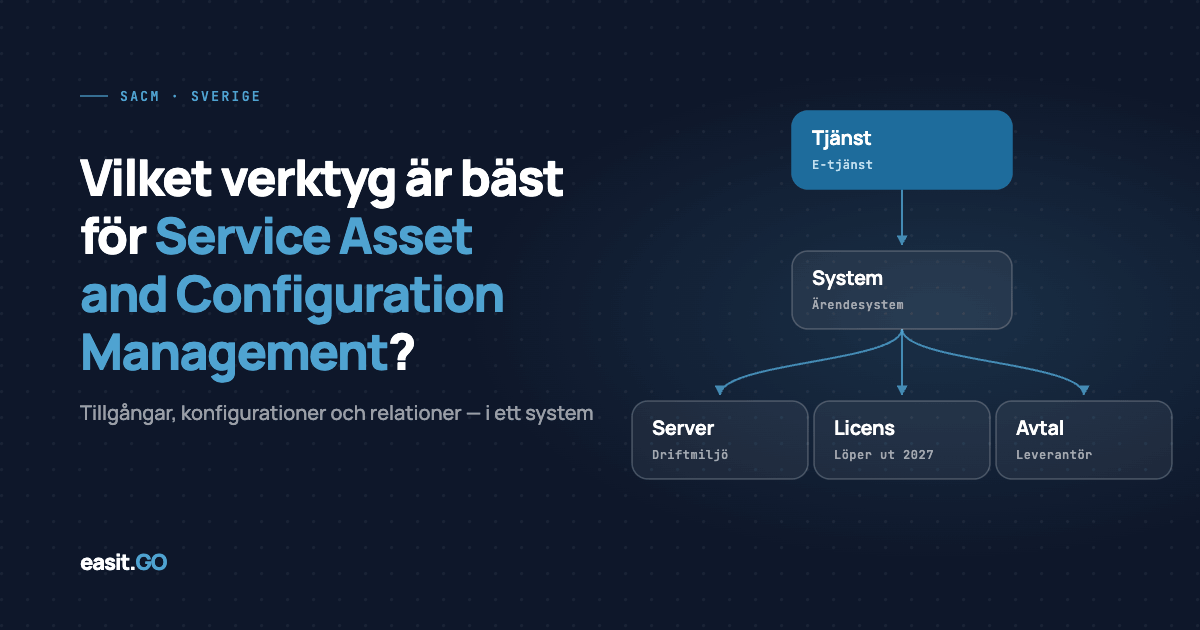
Service Asset and Configuration Management is the ITIL process for keeping track of the assets and configuration objects that make up IT services, and how they depend on each other. In ITIL 4, the area is divided into two practices: service configuration management, which deals with configuration objects and relationships, and IT asset management, which deals with the lifecycle and economics of assets. The term SACM lives on because most organizations work with both parts in the same tool.
At its core is a CMDB, a configuration database. It answers questions like: What services are affected if this server goes down? Who owns the system? What licenses and agreements are associated with it? What changes have been made in the last month?
Why SACM has become more important
NIS2 requires risk management, incident reporting and supply chain control. This cannot be achieved without knowing which systems are mission-critical and what they depend on. When a vulnerability is discovered, you should be able to quickly see which systems are affected, which services are affected and which supplier is responsible. This is exactly what a well-managed CMDB provides.
The same applies to change management. A change that is assessed without dependencies being visible becomes a guess.
How to choose SACM tools
Criterion | Question to ask the supplier |
Flexible data model | Can we define object types, attributes and relationship types ourselves without a consultant? |
Visual dependencies | Can a case manager see a relationship map directly from a case? |
Automatic inventory | What ready-made connections are available to inventory tools, AD and cloud services? |
Connection to the processes | Is the CMDB used for incident, problem and change, or is it a separate list? |
Integrations at no extra cost | Do API calls cost per transaction? |
Data storage | In which country is the data stored and operated, and by whom? |
Delivery form | Are both SaaS and in-house operations available? |
A common mistake is to start with the tool and try to record everything. This leads to a CMDB that no one trusts. Instead, start with the most critical services, model their dependencies, and automate the inventory before expanding.
SACM in Easit GO
In Easit GO you build your configuration database with relational models, where you decide which objects and relationships should exist. The relationship map shows the dependencies visually, so that the case manager sees what is directly affected in the case. Since the CMDB is part of the same platform as incident, problem and change management, it is used in daily work instead of becoming a separate register.
To keep data up to date, there are ready-made connectors, including to vScope and AD/LDAP, and with GO Connect you connect to more sources via low-code or code. The APIs (REST, SOAP and GraphQL) have no transaction-based cost. Easit GO is delivered as SaaS from Swedish data centers with Swedish personnel, where no data leaves Sweden, or for operation in your own environment.
If you would rather run GO on-premises, that's just as well. You don't lose any functionality compared to running GO from our data center and there are no additional costs.
Frequently asked questions
What is the difference between SACM and CMDB? SACM is the process and the way of working. CMDB is the database where the information about configuration objects and their relationships is stored.
Do we need a CMDB to meet NIS2? NIS2 does not require a named CMDB, but the requirements for risk management and incident management require that you know what systems you have and how they are connected. A CMDB is the most common way to get that control.
How do we keep the CMDB up to date? Through automatic inventory from existing sources, clear owners for each object type, and the change process updating the CMDB as part of the flow.
Where should we start? With your most critical services. Model them and their dependencies first, and then expand step by step.
Would you like to know more and see how Easit GO can help you in your business? Contact us and we'll have a coffee and a briefing.

Henrik Traveler
Commercial Product Manager
henrik.resare@easit.com
+46 70 249 36 06