
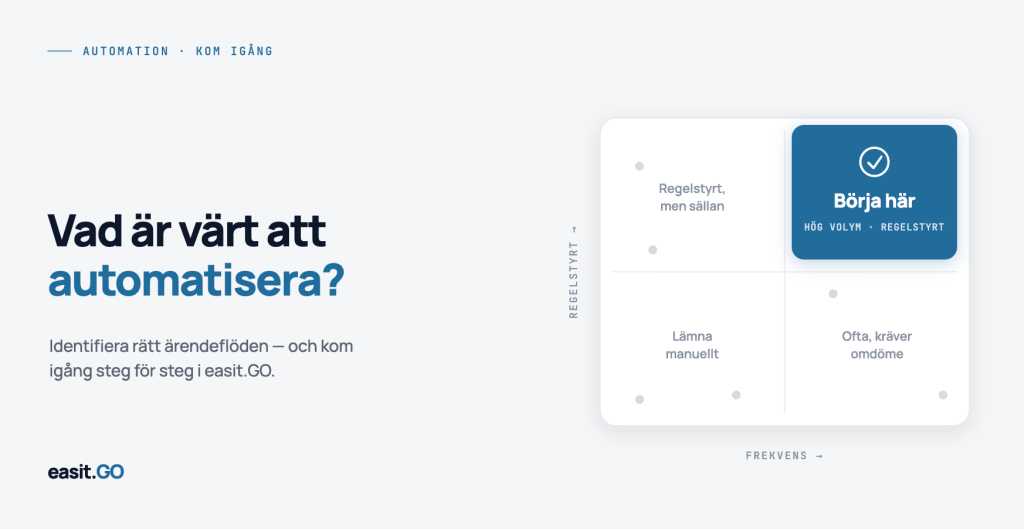
Many organizations use their case management system reactively, someone submits a case, someone handles it. It works, but it doesn't scale. And it leaves a lot of space for work that shouldn't require a human. This guide is about how you identify that space and start filling it with automation.
Why manual labor is more expensive than it looks
The obvious cost of manual case management is time. The less obvious cost is inconsistency.
Every time a human makes a decision about how to categorize a case, who to assign it to, and what response to send, they are making a new decision. Sometimes it is right. Sometimes it is wrong. Often it varies depending on who is handling the case, how it was worded, and what day it is.
Automation eliminates the variable. It's not about replacing human judgment, it's about reserving human judgment for situations that actually require it.
Escalations, assignments, status updates, notifications, reminders: these are mostly rule-based decisions. We describe how this works in practice in five processes that IT can automate. If a case has a certain priority, it is assigned to a certain group. If a case has not received a response within a certain time, it is escalated. If a case is closed, a confirmation email is sent. None of this requires a new decision every time.
What you automate are not tasks, they are rules
That is an important distinction.
Automation is not about removing tasks. It's about creating the rules that govern how work is done.
And those rules already exist in your organization. They're in your colleagues' heads, in informal guidelines, in the responses that are always sent to certain types of cases. Automation is about making those rules explicit and having the system apply them consistently.
This means that starting with automation doesn't require you to invent something new. It requires you to map out what you already do and ask: is this a decision that is always made the same way? If the answer is yes, it's a candidate for automation.
Three questions to identify what you should automate
Review your case management process and ask three questions:
Which cases are always handled in the same way?
If a certain case type is consistently assigned to the same group and receives the same response, a human doesn't need to make that decision again.
Where do bottlenecks occur due to waiting?
If cases get stuck in a queue while someone manually monitors statuses or sends reminders, that's work that the system can take over.
Which escalations occur reactively?
If escalations are initiated by someone noticing that a case has been pending for too long, they should be initiated by a rule that says exactly that, before the situation arises.
How automation works in Easit GO
In Easit GO, automation is built through the rules module. A rule consists, somewhat simplified, of three parts: a trigger that starts the rule, a condition that determines under what circumstances it should apply, and an action that defines what should happen.
A rule can be triggered when a case is created, check if it belongs to a certain category and automatically assign it to the correct group, set priority, and send a confirmation email to the submitter. This entire flow happens without a case manager needing to take a single action.
The same logic applies to time-dependent rules. If a case has not received a response within four hours, it is automatically escalated. If a case has been open for seven days without activity, a reminder is sent to the case owner. The rules run consistently. They don't forget, don't take vacations, and don't vary depending on who is on duty.
The rules are built in Easit GO's Design Studio, by a designer, without programming skills. They can be activated, deactivated and adjusted without affecting the basic structure of the system.
Where to start and why it matters
The most common mistake in automation is trying to automate too much at once. The result is rules that interact in unexpected ways, exceptions that are not handled, and an organization that loses trust in the system.
A better approach is to start with a single, well-defined flow. Choose a case type that is high in volume, simple in logic, and easy to measure. Build the rule, verify that it works as intended, and measure the impact.
Automation builds on itself. Every rule you add gives you data about what works and what needs to be adjusted. It also gives you an organization that understands how the system behaves, which is the prerequisite for being able to expand with more and more complex rules later.
It's also worth remembering that automation is not a project. It's an ongoing effort. The organizations that succeed best with automation are those that treat it as part of their ongoing management and not as a one-time effort.
Frequently asked questions
What is automation in case management?
Automation means that the system performs rule-based actions without manual intervention – assignment, escalation, notification, status update – based on conditions you define. Human judgment is reserved for situations that actually require it.
Does automation require programming in Easit GO?
No. Automation rules are built in Easit GO's Design Studio by a designer, without code. The logic is defined with triggers, conditions and actions in a visual interface.
Where should you start with automation?
Choose a case type with high volume, simple and consistent logic, and easy measurability. Build a rule, verify that it works as intended, and measure the impact before building further.
Can you automate too much?
Yes. Automation that is not well-defined creates unpredictable behavior and erodes trust in the system. Start small, build understanding, and expand incrementally.
Automation is not about replacing people, it's about making sure the right decisions are made consistently, at the right time, every time. It starts with mapping out what you already do and asking yourself if the system can do it for you.
Want to see how automation rules work in Easit GO in practice? Book a demo
Read also

Henrik Traveler
Commercial Product Manager
henrik.resare@easit.com
+46 70 249 36 06